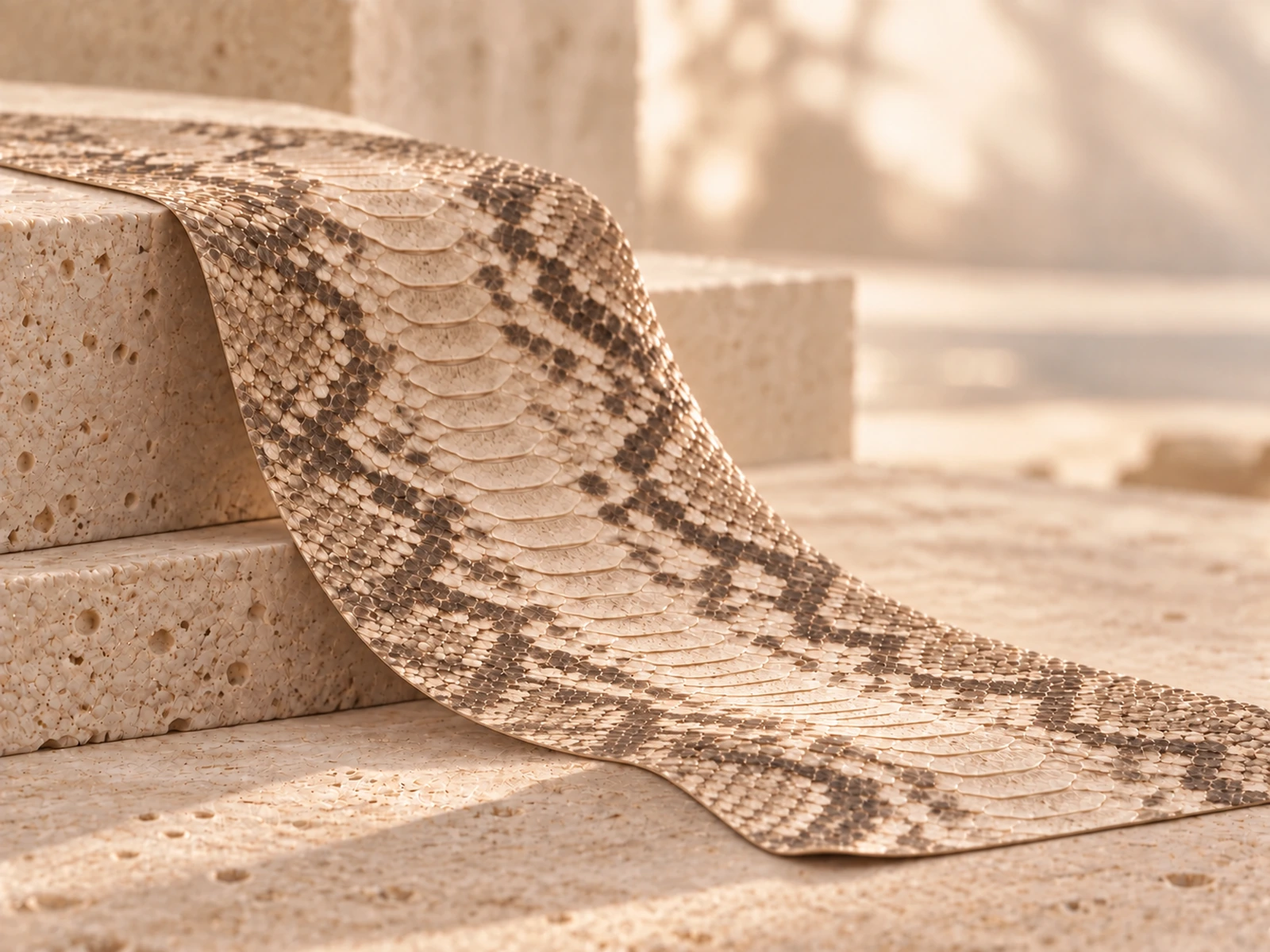
Python Leather
Python leather is valued for its natural scale pattern, lightweight structure, flexibility and distinctive character. Each skin has unique scale direction, tonal variation and texture, making it ideal for refined handbags, accessories and OEM exotic leather production.
Python Leather: Natural Pattern, Lightweight Character and Skilled Craftsmanship
Python leather is one of the most visually distinctive materials in the world of exotic leather. Known for its natural scale pattern, lightweight structure, flexibility and unmistakable character, it has long been used for handbags, wallets, shoes, accessories and other premium leather goods.
Every python skin has its own pattern.
The shape, size, direction and color transition of the scales vary naturally from one skin to another. This means that even when two products are made from the same design and finished in the same color, their surface patterns will never be exactly identical.
For this reason, creating a refined python leather bag requires more than simply cutting and stitching the material. The maker must understand how the scales move, how the natural pattern should be positioned and how the leather will behave once shaped into a finished product.
At JewelPelle, this relationship between natural material, pattern placement and craftsmanship is an important part of the way we approach python leather products.
What Makes Python Leather Special?
Python leather stands apart from many other exotic leathers because of its combination of lightness, flexibility and highly recognizable surface texture.
Its scales create a natural rhythm across the skin, while the relatively thin structure of the material makes it suitable for designs that require softness, movement and a lighter overall feel.
A well-made python leather handbag can therefore look luxurious without appearing heavy.
The beauty of the material comes from the way the natural scales interact with color, light and movement.
Depending on the finishing technique, python leather can appear soft and understated or bold and highly expressive.
Natural Scale Pattern and Individuality
One of the defining characteristics of python leather is its natural scale pattern.
Like many natural exotic leathers, each skin has subtle differences in scale size, direction, tonal variation and overall composition.
These variations give the finished product individuality.
For designers, the challenge is not to eliminate every natural difference but to use the pattern intelligently.
The center of the skin, the direction of the scales and the transition toward the sides can all influence the visual balance of a bag.
This is especially important when creating a python leather handbag with a symmetrical or structured front panel.
Careful pattern placement allows the natural skin to become part of the design itself.
Lightweight and Flexible Structure
Compared with many other exotic leathers, python leather is relatively lightweight and flexible.
This gives designers greater freedom to create softer silhouettes, refined folds and more fluid structures.
For customers, the lower weight can also make a larger bag more comfortable to carry.
The material remains visually rich because the scales provide texture even when the overall structure of the bag is simple.
This balance between lightness and visual impact is one of the reasons python leather works so well in contemporary handbag design.
Texture, Touch and Finish
Despite its scaled appearance, professionally processed python leather can feel soft and refined.
Its tactile character depends greatly on the finish.
Some python skins feel smooth and polished, while others retain more natural scale definition.
This creates a sensory quality that is very different from smooth calfskin, crocodile leather or stingray leather.
The result is a material that can feel both delicate and exotic at the same time.
Matte Python and Glazed Python
Python leather can be finished in several ways, but two of the most recognizable styles are matte and glazed.
Matte python has a softer, more natural appearance with less surface shine.
The scale structure remains clearly visible, and the edges of some scales may sit slightly above the surface as part of the natural character of the material.
This finish is well suited to modern, understated and more organic designs.
Soft, natural, contemporary and tactile.
Glazed python has a more polished surface with stronger light reflection.
The finish can enhance color depth and make the scale pattern appear more defined.
It is often used when a more dramatic, luxurious or formal appearance is desired.
Polished, expressive, refined and luminous.
Neither finish is inherently better than the other. The choice depends on the intended design and overall aesthetic of the product.
Color, Light and Visual Depth
Python leather is particularly interesting because it can be finished in a wide range of colors.
Natural tones highlight the original pattern of the skin, while black, grey, blue, green, red and other fashion colors can create very different personalities.
Because the scales and underlying pattern remain visible, color on python leather rarely feels completely flat.
Instead, tonal variation can create depth and movement across the surface.
This allows the same material to work in both classic and modern collections.
A natural python leather bag may feel organic and understated, while an emerald green or black python leather handbag can appear bold and highly contemporary.
From Python Leather to Handbags
Python leather is suitable for many types of bags, including structured handbags, shoulder bags, crossbody bags, clutches and small leather goods.
The most important design consideration is often pattern direction.
If the natural scale pattern is positioned carefully, it can create visual balance and lead the eye naturally across the product.
For a symmetrical handbag, matching the pattern across the front panel may require precise leather selection and cutting.
For a softer bag, the direction of the scales can be used to enhance movement and shape.
This is why experienced python leather manufacturing involves more than simply following a paper pattern.
The natural structure of the skin needs to be considered as part of the design process.
The Craftsmanship Behind Python Leather Bags
Python leather may be thin and flexible, but it still requires specialized handling.
The structure of the scales means that cutting, folding, edge finishing and stitching must be done carefully.
Working against the natural scale direction can increase the risk of lifting or damaging the scale edges.
For premium handbags, additional attention may also be required to achieve symmetry and visual continuity.
This is especially important when the design uses a large section of the skin across the front of the bag.
The quality of the finished product therefore depends on several elements working together:
material selection, pattern placement, cutting, construction, stitching and finishing.
A beautiful python skin does not automatically become a beautiful handbag. Skilled production is what transforms the material into a finished product.
Understanding the Natural Scale Surface
Python leather does not behave like completely smooth leather.
Depending on the finish, especially with matte python, the edges of some scales may naturally sit slightly above the surface.
This does not necessarily mean that the leather is damaged.
However, excessive friction, rough handling, very dry conditions or cleaning against the direction of the scales can cause them to lift more significantly.
For this reason, appropriate care is important for preserving the natural surface.
Durability and Everyday Use
Python leather can perform well over time when it is properly processed, constructed and cared for.
Its durability is different in character from crocodile or stingray leather.
Python is valued more for its flexibility, lightness and natural scale texture than for an extremely hard surface.
For daily use, it is advisable to avoid strong abrasion, sharp objects and prolonged rubbing against rough surfaces.
With appropriate handling, a well-made python leather product can retain its beauty and distinctive character for many years.
How to Care for Python Leather Products
Proper care helps maintain the flexibility, color and scale structure of python leather.
Use a clean, dry and soft cloth to gently remove dust.
Always wipe in the direction of the scales rather than against them.
Aggressive rubbing may cause the scale edges to lift or bend.
Avoid prolonged contact with water.
If the leather becomes wet, gently absorb the moisture with a soft dry cloth and allow the product to air-dry naturally in a shaded, well-ventilated place.
Do not use a hair dryer or expose the bag to strong direct heat.
If conditioning is required, use a product specifically suitable for python leather, reptile leather or exotic leather.
Apply only a small amount and test it first on a less visible area.
Heavy creams, oils or waxes may collect around or beneath the scales and should be avoided unless they are specifically formulated for python leather.
Store python leather bags in a breathable dust bag away from direct sunlight, excessive heat and high humidity.
For structured handbags, use light internal support to maintain the shape without overfilling.
Avoid placing heavy objects on top of the bag for long periods.
Storage, Heat and Sunlight
Direct sunlight and excessive heat can affect python leather over time.
Prolonged exposure may cause color fading and may also dry the leather, making the scale edges appear more pronounced.
For this reason, python leather bags should not be left for long periods in hot cars, near heating sources or in strong direct sunlight.
A cool, dry and ventilated environment is preferable for long-term storage.
The Cultural Symbolism of Python Leather
Snakes have carried symbolic meaning in many cultures throughout history.
Because snakes shed their skin, they are often associated with transformation, renewal, adaptability and change.
In some traditions, they may also be linked with strength, protection, prosperity or the idea of moving smoothly through challenges.
These meanings belong to cultural interpretation rather than the physical properties of python leather, but they add another layer of story and symbolism to the material.
Legal Sourcing and CITES
As with other exotic leathers, responsible and legal sourcing is an important consideration.
International trade in certain python species and python leather products may be regulated under CITES — the Convention on International Trade in Endangered Species of Wild Fauna and Flora.
For brands, manufacturers and importers, this means that species identification, source documentation and appropriate trade permits may be required depending on the material and destination market.
Python leather can come from legally managed farming systems or other regulated sources, depending on the species and country of origin.
For professional production, transparency and compliance are important parts of working with exotic leather.
Python Leather in Modern Design
One of the greatest strengths of python leather is its versatility.
Natural colors can highlight the organic pattern of the skin.
Dark colors can make the material appear more refined and understated.
Bright or fashion-forward colors can turn the scale pattern into the main visual feature of the bag.
Python leather can also be combined with smooth leather, metal hardware and other materials to create different levels of contrast.
This gives designers the ability to create products that range from classic and elegant to modern and bold.
Every Python Skin Is Naturally Unique
The beauty of genuine python leather lies in something that cannot be perfectly standardized.
The scale pattern, color transitions, width of the skin and natural rhythm of the surface are all formed by nature.
As a result, two products made from the same design will not have exactly the same pattern.
These differences are not something that need to be hidden.
They are part of the identity of the material.
The beauty of python leather is not found in making every piece identical, but in allowing the natural individuality of each skin to become part of the finished design.
JewelPelle: Python Bag Manufacturer in Thailand
JewelPelle is a python bag manufacturer in Thailand, specializing in exotic leather bags, accessories and custom production.
Our work with python leather focuses not only on construction, but also on understanding the natural direction, scale structure and visual rhythm of each skin.
For a refined python leather handbag, pattern placement can strongly influence the finished appearance.
A symmetrical design may require careful alignment of the central pattern.
A softer or more relaxed bag may use the natural direction of the scales to enhance movement.
Different colors and finishes can further change the personality of the product.
At JewelPelle, we treat the python skin as part of the design rather than simply as a decorative surface.
Exotic Leather Bag Manufacturing for Brands
As an exotic leather bag manufacturer in Thailand, JewelPelle works with brands, designers, importers and professional buyers developing products in python and other exotic leathers.
Depending on the project, our manufacturing support can include:
- selection of suitable python leather
- color and finish development
- review of product construction
- hardware selection
- pattern development
- prototype and sample making
- scale direction and pattern placement
- production of finished bags and accessories
- OEM and Private Label manufacturing.
The objective is to translate a design concept into a finished product while respecting both the natural material and the visual identity of the client's brand.
OEM Python Leather Bag Manufacturing
For brands developing their own collections, OEM python leather bag manufacturing requires attention to details that are different from conventional leather production.
Natural python skin contains visual variations that need to be considered during product development.
Scale direction, usable skin area, natural pattern placement, thickness and finish may all influence the final design.
For this reason, python leather should ideally be considered from the beginning of pattern development rather than added only after the bag structure has already been finalized.
JewelPelle can work from customer sketches, reference products, concepts or technical specifications.
Depending on the project, this may include:
- sample development
- adjustment of dimensions
- adaptation of construction
- positioning of the python pattern
- material and hardware selection
- production planning.
This process is especially valuable for brands looking for OEM python leather bags with a consistent design identity while preserving the individuality of genuine python leather.
Custom Python Leather Bags
Custom production allows a brand to decide how the natural python pattern should appear within its collection.
Some designs may emphasize the center pattern and symmetry.
Others may use the skin more freely to create movement and a more organic look.
Python leather can also be combined with smooth leather, metal hardware or contrasting materials.
Different finishes and colors can produce a completely different result even when the same base design is used.
At JewelPelle, our goal is not simply to make a bag covered in python leather.
Our goal is to understand the natural pattern of the skin and use it deliberately as part of the design.
JewelPelle: From Natural Python Leather to Finished Product
The beauty of python leather begins with what nature has already created — its scales, direction, tonal variation and individual pattern.
The role of craftsmanship is to understand those characteristics and translate them into a finished product.
At JewelPelle, we apply this approach to python leather bags, python leather handbags, custom exotic leather products and OEM manufacturing.
For brands, designers and professional buyers looking for a python bag manufacturer in Thailand, an experienced exotic leather bag manufacturer, or a partner for OEM python leather bags, our focus is on combining natural material, thoughtful design and skilled production.
Because the value of genuine python leather is not simply that every skin is different.
It is knowing how to make that difference beautiful.
Natural pattern. Lightweight character. Skilled craftsmanship. Made in Thailand by JewelPelle.