Stingray Bags: Where Natural Material Meets Craftsmanship

A stingray bag begins long before the first stitch. It begins with the skin itself.
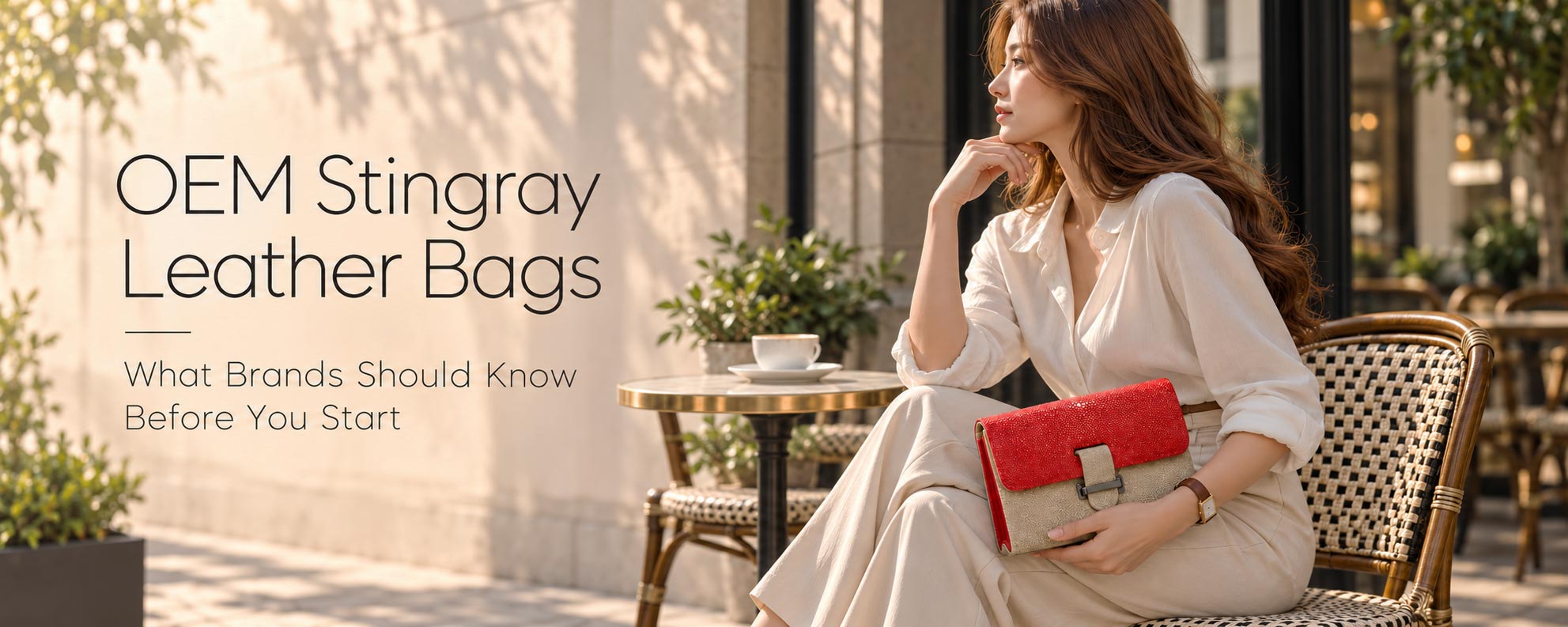
Unlike conventional leather, stingray leather has a naturally distinctive surface formed by thousands of small calcified scales. At the center of many skins is the characteristic white marking commonly known as the pearl. No two skins are exactly alike.
Explore related styles in JewelPelle's Stingray Bag category.
For JewelPelle, manufacturing a stingray bag is not simply a matter of placing a pattern onto leather and cutting it. The craftsman must first understand the skin: its texture, usable area, pearl position, scale pattern, color variation and how those details should appear on the finished bag.
What Makes a Genuine Stingray Bag Different?
Stingray leather has a character that is difficult to reproduce with conventional leather. Its dense, textured surface is naturally resistant to abrasion, while the distribution of its scales creates subtle variations across every skin.
The pearl adds another dimension. Depending on the design, it can become the visual centerpiece of a handbag, appear subtly within a panel, or be intentionally excluded to create a cleaner and more contemporary appearance.
This gives designers considerable freedom. A stingray bag can look distinctly exotic, or it can be designed in a much more understated way where the texture becomes the main expression of the material. At JewelPelle, we work with both approaches.
The Skin Comes Before the Pattern
With ordinary leather, a manufacturer can often focus primarily on maximizing cutting efficiency. Stingray requires a different way of thinking.
Before cutting begins, we consider the size of the skin, pearl position, scale pattern, usable area, color variation and the dimensions of the finished bag. For a symmetrical handbag, two areas may need to be carefully matched. For a clutch, the pearl may need to fall precisely at the center. For a more minimalist design, the pattern may deliberately use another area of the skin.
This is one of the reasons experience matters when producing genuine stingray bags. You do not simply cut stingray leather. You design around it.
Craftsmanship You Can See and Construction You Cannot
The exotic leather may attract attention first, but a beautiful skin alone does not make a well-made bag. Construction matters just as much.
Edges must be finished cleanly. Panels must maintain their intended shape. Linings need to sit correctly. Hardware must work naturally with the construction. Handles and straps need reinforcement appropriate to their function.
Because stingray leather has a harder surface than many conventional leathers, cutting, skiving, folding and stitching require techniques adapted specifically to the material. These details are particularly important in OEM manufacturing, where production quality depends on repeating the same details consistently across an order.
Making Better Use of Every Stingray Skin
A stingray skin should not be viewed only as a single handbag panel. After the main sections have been selected for a bag, smaller usable areas can still have considerable value.
Depending on their dimensions and quality, they may become parts of wallets, card holders, jewelry, accessories, decorative components or other small leather goods. This matters because stingray leather is a natural material with a limited usable area.
At JewelPelle, our experience across stingray bags, small leather goods, jewelry and decorative products allows different sections of a skin to be considered for different applications. The objective is simple: use the best section where it matters most, and waste as little usable material as possible.
Legal Sourcing, CITES and Export Documentation
Exotic leather requires another level of consideration beyond appearance and craftsmanship. International wildlife trade is regulated according to species, origin and destination, and requirements are not necessarily identical for every type of stingray or every market.
JewelPelle works with legally sourced materials and considers applicable documentation and trade requirements when developing exotic leather products for international customers. For species, shipments or destination markets that require CITES or other wildlife-trade documents, the proper documentation is handled as part of the export process.
For OEM buyers, this is an important part of product development, especially when a collection is intended for export.
Stingray Bag OEM and ODM Manufacturing in Thailand
JewelPelle has worked with leather craftsmanship and manufacturing in Thailand since 1985. With more than 40 years of experience, we develop and manufacture genuine stingray leather products for international brands, designers, wholesalers and businesses.
Our capabilities include:
- Custom stingray handbags and shoulder bags
- Stingray clutches, wallets and small leather goods
- Stingray jewelry, accessories and decorative products
- OEM and ODM product development
- Material selection and pearl positioning
- Pattern making, sampling and production
- Logo embossing, branding and packaging development
- Flexible minimum order quantities depending on the project
Customers may begin with a drawing, reference sample, existing design or simply an idea. From there, our team can work through material selection, construction development, pattern making, sampling and production.
For established brands, this provides access to specialized exotic leather manufacturing. For emerging designers, it provides an opportunity to develop a product together with a factory that understands how stingray leather behaves before committing to larger production.
More Than a Stingray Bag Factory
Anyone can look at a finished stingray handbag and see the exotic surface. The more important work is underneath it.
It is knowing which skin to select, where to place the pearl, how to cut around the natural characteristics, how to construct the bag correctly, how to make better use of the remaining material and how to consider the legal requirements of exotic leather trade.
That combination is what turns a skin into a product. It is what separates simply working with stingray leather from understanding it.
JewelPelle is a stingray bag manufacturer in Thailand, an exotic leather bag manufacturer, and an OEM and ODM production partner for brands worldwide.
Respect the material. Understand its character. Craft it to last.
Interested in custom stingray bag or exotic leather OEM manufacturing?
Contact Jewelpelle